Help Isom IGA recover from devasting floods

At The NGA Show 2026, IGA CEO John Ross delivered a keynote presentation about the grocery landscape. During Onward to 2030: A Look at Changing Shopper Behaviors Through Decades' End, Ross looked ahead to explore how shopper expectations, purchasing patterns, and loyalty drivers are transforming in the industry as we approach 2030, and what independent grocers must do today to stay ahead. In the column below, Ross details how the U.S. went from a third-world country in GDP to the first position as a first-world country. For more details, watch his presentation at The NGA Show, and return next week for part two of his column.
Over the long run, what would success look like in our country? Specifically, what metrics would you use to judge whether you are making progress as a nation, and whether that progress was ahead of competitor nations?
I’m not talking about short-term numbers or social issues, but longer-term economic ones.
If we went back in time to 1826, and asked, "Where do we want the U.S. to be in 200 years?", what would our forefathers have said?
We were at the brink of the industrial revolution, with the impending launch of coast to coast transportation (trains) and breakthroughs in communications technology (telegraph) and infrastructure (the electrical grid). The U.S. was about to shift from a third-world country — using approximated Gross Domestic Product (GDP) as a metric — to a first-world economy. In fact, first in the first world.
How did we do it?
To understand how we went from small to world-powerhouse, you have to break GDP down into its parts:
GDP Growth = Labor Growth + Capital Accumulation + Productivity
Grow any one of these metrics and your country’s overall economic power would grow. Grow two and you have break-out results.
The U.S. grew all three.
Over that 200 years, the country grew its total population from about 10 million people to 350 million through immigration, compounded replacement, and a breakthrough in longevity in the 20th Century.
The U.S. invested heavily in industrialization and the government would spend heavily on infrastructure — railroads. roads, bridges, and electrical transmission systems — and energy exploration, which would not only create massive amounts of corporate profits, but mark the U.S. as the best place for foreign capital to invest. In fact, the U.S. Dollar overtook European currencies to become the safe-haven standard for the entire world.
Finally, our productivity skyrocketed. That means we got more profit per worker, and more return per capital dollar invested. It turns out that private investments in industrial standardization, innovation, communications, and transportation infrastructure let the U.S. become a manufacturing, and later technology, powerhouse like the world had never seen.
So here we are, on the brink of the U.S.' 250th birthday. It might be good to look at those same metrics and ask, "How are we doing today? Are we still on the path to economic prosperity? Are our short-term policies going to hamper or accelerate our economic future in the long term?" Let’s break it down.
Labor Growth
More workers equal more tax revenues. More tax revenues allow companies and governments to make more investments. More investments equal job growth, wealth accumulation, and all good things to happen.
Compared to many countries in the world, like most of Western Europe, Japan, and even China, the U.S. is doing okay: our population is growing, although at a slowing rate. But today and for the next couple of decades we will end each year with more Americans than we began.
Why is that a good thing? Let’s look at what happens when you shrink: fewer babies and more old people are not good for an economy. When you end up with more citizens who consume resources (older, sicker, non-tax contributing) than those that add to the resource pool (younger workers who pay taxes), total revenues shrink well. Look at Spain, Japan, and Greece as examples. Your economy shrinks, productivity goes negative, and disastrous things happen to your tax base as social support services outstrip revenues.
Remember, I am talking about the long term; this isn’t a political argument based on current events. It is mathematics, based on long term data. To grow your country’s economy, you need to grow your population. And the U.S. has been growing, mostly through immigration.
Now, you can still grow your economy with the same number of citizens if you get more productivity per worker. And we have been doing that, too.
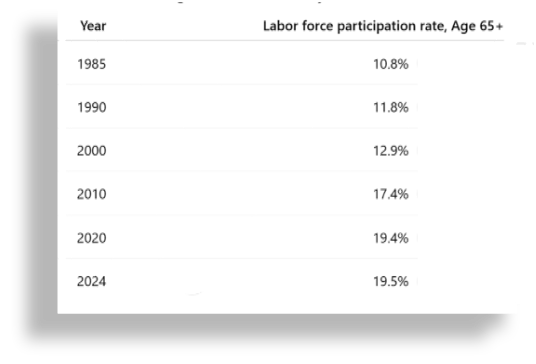
Today, according to the U.S. Census Bureau (see above chart), the number of U.S. adults working into their 60s has nearly doubled from 40 years ago. More productive work life equals a longer tax base. Whether this is because they are healthier and able to work, or whether they need to work because they can’t make ends meet is up for debate, but the math doesn’t lie. We get a longer productive tax base from American workers today than we did a generation before, and that trend continues.
The American worker is also more productive per hour worked. The U.S. Department of Labor also shows that the productivity per hour worked has skyrocketed and continues to set new highs (see below graph). Why? Technology and education.
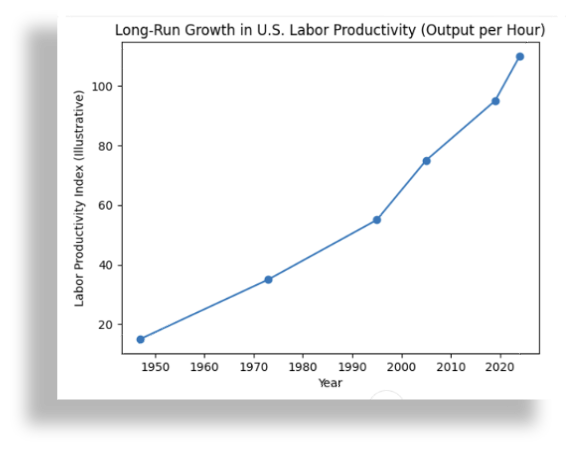
Mobile phones, the internet, and automation all contribute to a massive multiplier effect for the U.S. Just like production lines and standardization were able to revolutionize heavy manufacturing at the turn of the last century, communication technology is letting our country blast forward as an economic powerhouse.
Education has also been a massive competitive advantage for the U.S. It might not seem like it watching news broadcasts about sliding math scores in schools but compared to the rest of the world we have one of the most highly skilled, technology-literate populations today.
While we aren’t talking about it in the news, immigration has always been a competitive advantage for the U.S. Waves of immigrants from Asia, and Western and Central Europe fled their home nations, bought their trade skills, acculturated and became a part of the U.S. labor force in the last 200 years. Whether fleeing religious persecution or economic disaster, these immigrants came to our country, contributed to the tax base, and had babies who became American citizens. And with each generation, they invested in their children to help them build a better life.
Grow your population, get them to contribute taxes longer, and make them radically more efficient per labor hour worked, and you can grow your country’s economic power.
Wealth Accumulation
When foreigners invest in the U.S., that is a good thing. They give us their wealth, which we invest in our businesses, which allows us to make money off their money. Foreign investment is a great thing. It makes us stronger, not weaker.
The U.S. has been the platinum standard for over 100 years. We are safe, we are predictable, our government is pro-business and pro-growth, and as a consequence, foreign markets see the U.S. as a safe place to park their money.
Well, that used to be universally true, but capital markets don’t like unpredictability. Federal trade policies that put us at war with others (tariffs) and radically changing global political policies cause foreign investors to pause. And when those markets see the U.S. as unstable, they will draw down their investments and put them elsewhere.
One of the hypotheses about the higher tariff model would be that factories would re-shore, that U.S. manufacturing would skyrocket. So far, the opposite has happened: manufacturing jobs in the U.S. are down over 80,000 YTD and likely to get worse.
In fact, the winners in the current trade war are countries like Vietnam and Mexico, where suppliers are choosing to invest in production to avoid punitive trade and mercurial economic policies.
You can see it happening in two statistics: the plummeting U.S. dollar and exploding gold prices. Those are signals that the world sees the U.S. as unstable.
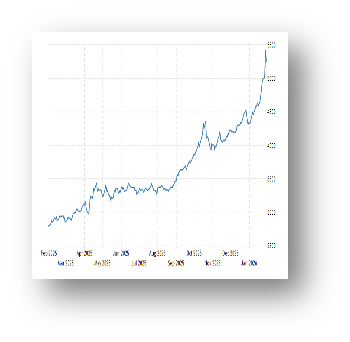
Gold price per ounce
You would think that a weaker dollar means our U.S.-made products would be cheaper and therefore more attractive to international customers. The opposite has happened.
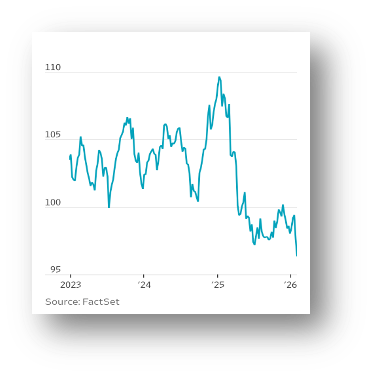
U.S. Dollar
Currently the trade imbalance is getting worse, not better. And nowhere has this hit harder than in U.S. agriculture. Trade wars impact farmers first. Domestic farming, beef, cattle, and pork industries rely on exports to make the economics of farming work. Currently U.S. farm exports are plummeting, primarily exports of soybeans, wheat, chicken and pork to countries like China. Total farm losses are likely to run into the $30 billion dollar range as the trade war goes on — way more than the $12 billion farm bailout currently being discussed.
Farmers are being hit hard with import tariffs, too. They have to pay almost double for fertilizer than what they spent a few years ago and imported farm machinery has skyrocketed, too. Higher materials and infrastructure costs and lower export volume mean a glut of domestic supply, which will send commodity prices plummeting. That’s real fear for small farmers in this country.
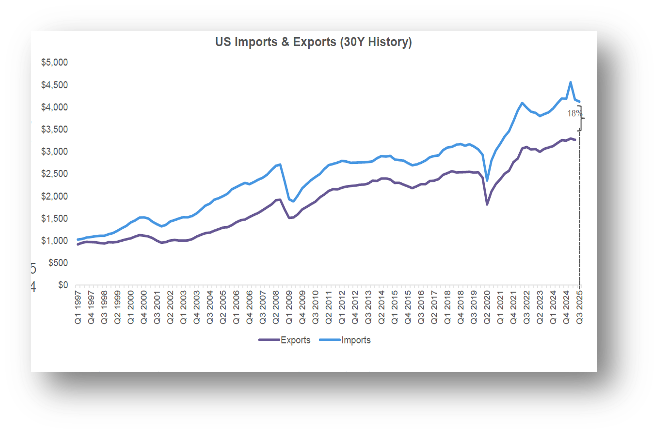
Tariff effects are insidious. They show up in raw materials, suppress exports, and destabilize capital systems. And it could get worse. There is a growing “Sell American” movement in international markets. The money is moving — moving to countries that appear less contentious and more stable — and if that trend continues, we could see the negative impact on farmers accelerate.
Productivity
The third component of GDP growth is productivity. Yes, this is linked to the labor productivity I discussed earlier, but it is much more than that. American innovation has allowed the U.S. to lead the world economically for generations. American aviation, energy exploration, entertainment, communications, computing, internet and eCommerce, medical, pharmaceutical, automotive, and so many more are (or were) leaders in their fields. The U.S. capitalism system rewards companies for innovating; the free market system allows money to flow and wealth to generate and accumulate, which encourages future investment, all of which generates growth.
Right now, the U.S. is doing well here. GDP was over 2% last year, and the stock market is hitting historical highs. All good.
But underneath those metrics is an emerging problem: most of the growth is coming from technology — a lot it from the promise of artificial intelligence, but also cloud computing, robotics, and automation. Strip out the tech stocks and the U.S. core infrastructure looks a lot less rosy.
The issue is that the high-tech world doesn’t distribute its wealth like traditional industry does. High tech is fast growth, high margin, while the core economy (manufacturing, retail, real estate, etc.) is steady growth, small margin.
Small margin in this context means good for the economy. If you only make 2% net, like we do in grocery stores, that means 98% of the volume is distributed across our industry. That means jobs in trucking, manufacturing, marketing and advertising, and services.
But in the tech world, with margins of 50% plus, their wealth concentrates in a much smaller group of hands —primarily the financial markets, not average workers. You can see it in the numbers as big companies like Amazon hit new profit highs yet still lay off thousands of workers.
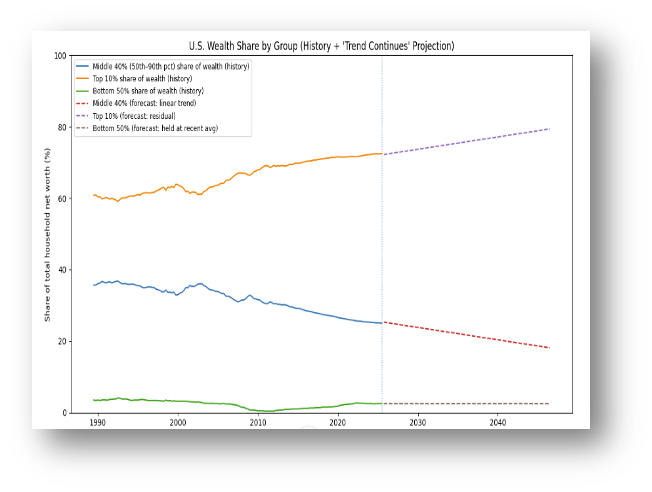
No wonder the U.S. middle class is eroding. Today more than two thirds of middle-class shoppers say they can’t make ends meet; half say they worry about the cost of feeding their families; a third say they can no longer afford basic necessities (2025; see above graph).
The middle class in this country is increasingly not actual “middle.” The majority now fall into the marginal middle-class category, where 100 percent of their income goes to pay for basic expenses with nothing leftover for savings or emergencies. With over a trillion dollars in credit card debt and little to no wealth, these families are always at risk.
The marginal middle class didn’t get to participate in the massive wealth accumulation in the U.S. over the last 20 years. If you didn’t own a home or have money in the stock market, you missed it. They missed it.
That's why consumer confidence is at Recession Era levels.The reliance on tech industries and the switch to a service-based economy has pushed wealth out of the hands of middle Americans and into a smaller, high-wealth minority at a faster rate than ever before.
Looking Ahead
In the long term, the U.S. has a lot going for it. We have a growing population, and that population is working longer and more productively. We are also leaders in productivity, thanks mainly to technology.
But underneath that we have a lot of areas for concern. Which is actually nothing new for our country. In our 250 years of existence, we have had lots of times where external factors — and our own policy decisions — have helped or hurt the U.S. in growth. And over the long term, we have always found our way. Economic policies and politics change all the time. Over the longer term, we as citizens have to make sure, we are focused on the stuff that matters and not distracted by the noise of the press, the media or whatever administration is trying to get elected.
Next week, I will examine these factors, go into depth what they mean for the grocery industry and for our shoppers, and share how we can adapt to the changing market, understand the barriers, exploit the opportunities, and grow.



No Comments Yet
Let us know what you think