Help Isom IGA recover from devasting floods

In my last article, I talked about the economic forces shaping our world both internationally and domestically. Here I will be focusing on the impact on American shoppers and, understanding how they are changing their behavior, a look at things we could do to serve them better while growing our businesses.
The first thing is to understand what makes up the average American shopper. Picture middle America: two-income working parents, a couple of kids, a mortgage, a couple of cars, a house in the suburbs? Probably a dog, too.
If that came to mind, then you are potentially out of sync. Over the last 30 years the ‘average’ American has been changing from that stereotype. A better word would be “slipping,” as the majority of the middle has lost ground in pursuit of the middle class dream of kids, cars, house, retirement.
Today, almost 70% of working middle class Americans say that normal expenses are falling below their income; half of middle-income Americans say they worry about the cost of feeding their family; and one third say they can’t make ends meet, even with both adults in the family working.
This may seem out of synch with the data you see in the news. After all, the stock market continues to push ever upward, home values continue to go up, and since COVID, the average income of all Americans went up. Right?
The real story is one of two Americas. In one camp you have middle and upper middle-class citizens who own a home, and have some form of savings like a 401k, bond fund, or stock portfolio. For these families, the rapid expansion in home values and the stock market have increased real wealth. They have grabbed the American dream and are riding it into a prosperous retirement.
For the other half of the middle class, the ones who weren’t able to purchase a home and have no 401k, stock portfolio, or savings program through work, they have missed out on the last 30 years of American wealth appreciation. In fact, they have gone backwards, with rent costs appreciating faster than personal income, just like the costs of education, childcare, medical care, insurance, and transportation have grown faster than two income working families can accommodate.
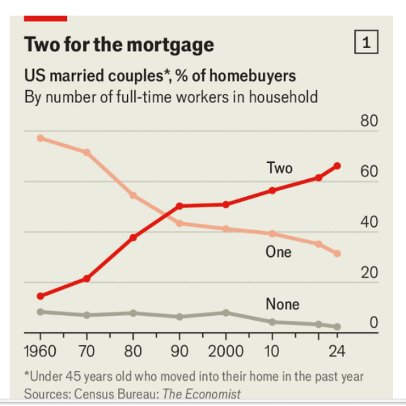
This latter half of the country’s middle class have moved into what is a called the “marginal middle.” This group spends everything they earn on basic expenses. And the majority could not afford to pay for an emergency of greater than $400.
Most Baby Boomers sustained the American dream by going from one-income households (like their parents) to two. Even with the cost of childcare, the two-income working family was able to afford a home, buy two automobiles, even save for college for their kids — just like their parents did a generation before.
What about today?
Now, the marginal middle class has to take on more than two jobs per two adults. With the growth of the gig economy — Uber, Grubhub, and Etsy, for example — these marginal middle-income shoppers are making ends meet by working more than ever before. More than one third of Americans participate in the gig economy, and three times as many adults work more than one job versus just a couple of decades ago.
And however tough it is for adults in their 40s, it’s worse those in their 30s and 20s. Young Americans increasingly feel they missed the wealth generation opportunity that helped their parents find economic independence. Saddled with student debt, working for companies with no pension or other savings programs, often forced to work two jobs, unable to purchase a home, and at the mercy of the health industry (so many are uninsured), they have a hard time seeing where to get on the path toward the seemingly fabled American dream.
No wonder consumer confidence is at an almost all-time low.
This isn’t a new phenomenon, but it is an accelerating one. Wealth has been concentrating in the upper tier of American households since the 1960s, and that trend continues. Today, middle America owns less than half the wealth it used to hold in our parents' generation. Stock appreciation and real estate have made Boomers the wealthiest generation in the history of the world, but even that static is skewed. Today, half of America owns almost nothing, the middle class owns less than one-third, and the top 1% owns more than everyone else below them combined.
Not just that, but most are in debt. Credit card debt in America is $1.21 trillion. That is equivalent to the entire national debt of the United States of America back in the 1990s!
We see this every day in our stores. Communities that were once squarely middle class have been slipping into poverty; entire small towns have been erased when employment stutters, and many urban communities have been essentially left out of the prosperity boom of the suburban upper middle class.
Note, I am talking about middle class Americans — working families, not the unemployed poor. I am focusing this discussion on our target shoppers: the American families trying to make it and often sliding father behind.
It is hard to see the human side of the averages. Stock market rocking, unemployment still at historic lows, energy and other commodity prices stable — on the surface it looks like we are doing well. And with the tech boom for AI, data centers, and more in full growth mode, our future looks bright. Right?
The issue with the tech industry is flow-through economics. And the secret is all in the margins. Let’s take a look at low margin, slow growth industries like construction, manufacturing, and grocery. Their low net margins mean that a large percentage of the total price of goods was distributed into the economy across multiple businesses.
Sell a can of beans in the grocery store at a 2% margin, which means 98% of the cost of the product went to farmers, processing plants, manufacturers, warehouses, and trucking companies. That drove factory investments, jobs, infrastructure, and even tax revenues.
Compare that to an AI company, where margins are high and growth is explosive. Good for their investors, but in the long run, not so great for the economy overall. With extremely high margins, the wealth is concentrated in a small group of technocrats and, importantly, equity investors. High growth businesses work because investors are willing to take risks for high returns. But that growth doesn’t filter into the economy like traditional industries. No wonder more and more wealth is being concentrated in fewer and fewer American hands.
It isn’t all doom and gloom. The internet-enabled future makes it easier for entrepreneurship than ever before. The young adults of today will go on to create more start-up businesses than any generation before them. The path to independence by owning your own business has never been brighter.
Technology is opening up some careers, even as it squashes others. With the advent of AI, once attractive degrees in computer sciences are beginning to decline, even as jobs in traditional trades are growing quickly.
In summary,
- More working Americans are economically stressed than ever before. And the rate of distress is likely to continue, at least for the short term.
- The rising cost of literally everything has made these families brittle. If anything goes wrong — a car repair or medical emergency — they must deficit spend.
- Food inflation has continued to rise. Today it is rising at 2.4% and is likely to increase depending on what happens with interest rates, tariffs, and other federal policies. That means the cost of groceries is only outstripped by the cost of eating out as the most significant ongoing pain point in their lives.
- Younger Americans, especially two-income families with young children, have it harder than ever.
- Cuts to programs like SNAP put two-income working poor at even greater risk.
So, what does all this mean for the grocery industry?
First, we need to understand and accept reality:
Our core shoppers are increasingly economically fragile."
Second, rethink how we can become allies in their fight to feed their families. We must rethink how we go to market to help our target shoppers win.
Strategies include:
- Understanding that many are working more than one job per adult, we can expand our range of convenience options to help them save time and money.
- Knowing they feel economically squeezed, we can offer a price guarantee, weekly loyal shopper discounts, and loyalty rewards.
- Realizing they have a hard time making ends meet, we can advance every promotion, deal, and savings opportunity (like the IGA national offers) so no shoppers ever miss savings they deserve.
- Hearing they need help, we can use content to educate them on ways to save with meal deals, bundles, rebates, smarter recipes, etc., wherever possible.
- Remembering the cost of dining out is rising faster than grocery prices, so we can make direct comparisons between the cost of the same meal cooked at home versus at a restaurant (like IGA does in Quarterly Marketing Kit signage).
These strategies aren't only for retailers — they must be adopted by our manufacturers as well. How can we extend value together? More discounts, coupons, and promotions are one set of tactics. We need creativity: bundles, cross department offers, convenience packs, and other ideas. For big brands, this means understanding that our core target audience needs us to be creative.
And for everyone in the industry, this means learning to use consumer data to serve our shoppers better. We have to stop thinking of loyalty programs as a marketing expense and instead see them as educational opportunities to help shoppers feel smarter. This means sharing content as well as savings. It means more than just rectangles with cents off, but videos, cooking instructions, value meal suggestions, and so much more.
Our industry invented modern marketing as we know it. And as pioneers, it is time we continue to push modern marketing, and reinvent it as education at scale. Helping our shoppers feel confident means they will shop smarter. And with higher quality meat, produce, fresh food, than national chains, it leads smarter shoppers right to the doors of well-run independents.


No Comments Yet
Let us know what you think